
A Conference for Aquatics: My First Professional Presentation
By Emma Fralin, Cornell DVM ‘25
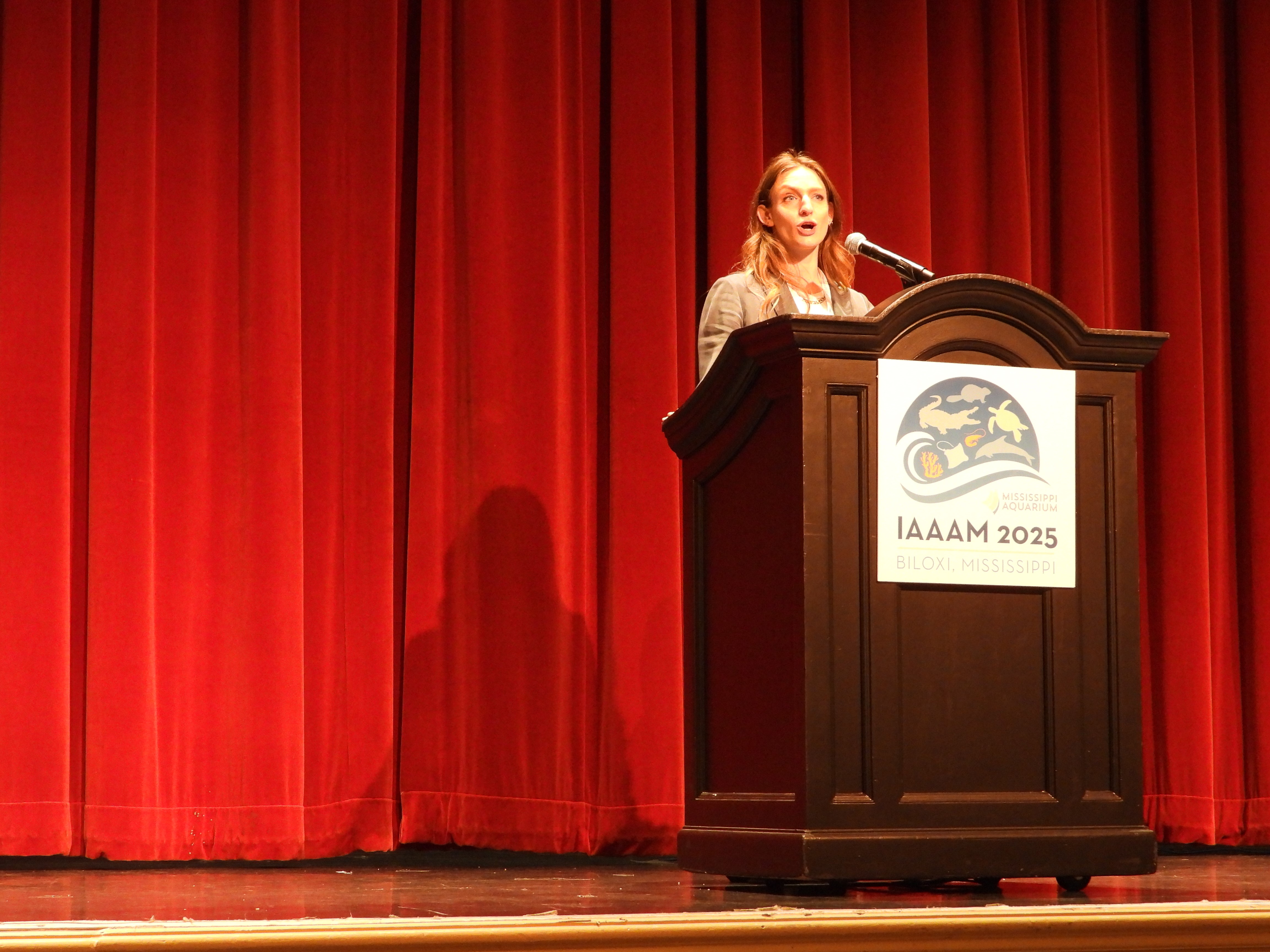
One of my primary goals during my veterinary education was to present at a professional conference to gain experience and build my network. I was able to achieve this goal by presenting at the 2025 International Association for Aquatic Animal Medicine (IAAAM) Conference in Biloxi, Mississippi, with the help of the Cornell K. Lisa Yang Center for Wildlife Health Student Support Fund.
At the IAAAM conference, I presented the findings of my research project with Dr. Sarah Sharp at the International Fund for Animal Welfare (IFAW) Marine Mammal Rescue (MMR). In 2023, I externed with the IFAW MMR team in Cape Cod, Massachusetts, which I wrote about in another blog post, What the Ocean Brings Us.
Investigating Dolphin Kidney Health
Under a federal stranding agreement between IFAW and the National Marine Fisheries Service under the Marine Mammal Protection Act, IFAW MMR responds to all stranded marine mammals along southeast Massachusetts and Cape Cod—a hotspot for strandings. Whales, dolphins, and porpoises (cetaceans) are considered stranded when they are found either dead (on the beach or floating in the water) or alive on the beach and unable to return to the water. Short-beaked common dolphins (Delphinus delphis) are one of the most commonly stranded cetacean species in the Cape Cod area (Sharp et al., 2016).
Renal pathology in cetaceans has been documented in both managed and free-ranging animals, including kidney stones, kidney infections, and acute kidney injuries. In recent years, there has been an observed increase in the incidence of renal stones in necropsied animals from Cape Cod. Of the 175 stranded short-beaked common dolphins in the study cohort, two adults were found to have clinically significant renal pathology.
Historically, kidney function in animals has been evaluated using the biomarkers creatinine and blood urea nitrogen, which increase only after about 75% of kidney function is lost. More recently, symmetric dimethylarginine (SDMA) has been identified as an alternative biomarker that can detect loss of kidney function much earlier, on average, when around 40% of kidney function is lost. SDMA has been studied in many species, including manatees and California sea lions, but not yet in dolphins.
During my externship, I investigated the relationship between two biomarkers of renal health in stranded short-beaked common dolphins. The results of this study showed SDMA and creatinine to be positively correlated in known survivors, meaning increased SDMA was often seen with an increase in creatinine. In non-survivors, no significant correlation was found. Using parameters established by Sharp et al. 2016, survivors were defined as animals successfully tracked via satellite tag for 21 days or more, while non-survivors were defined as animals who were humanely euthanized, died during transport, or were later found stranded and deceased.
These results represent an initial step in determining the clinical utility of SDMA for evaluating renal disease in stranded common dolphins. However, due to a low incidence of renal disease identified in clinical and necropsy findings, we cannot definitively conclude that SDMA correlates with renal disease.
Inspiration from the Field
In addition to presenting my own research, I was impressed by the diversity and innovation showcased at the conference. Topics ranged from infectious disease in corals to cardiac disease in dolphins, to assessing whale shark population health and preventing mosquito bites on penguins in aquariums. I found every topic enthralling and inspiring. I had the opportunity to network with the researchers behind the incredible work, which introduced me to new career pathways and possibilities in this field. I plan to continue pursuing research in the field of aquatic animal health so that I can contribute to the well-being and conservation of aquatic species.
Acknowledgements
Thank you to all the incredible staff, interns, and multitude of volunteers at IFAW MMR. This study would not have been possible without the guidance and mentorship of Dr. Sarah Sharp, as well as the statistical advice from Dr. Matt Thomas at Cornell Statistical Consulting and Dr. Patrick Carney from Cornell’s College of Veterinary Medicine. Thank you to the Cornell K. Lisa Yang Center for Wildlife Health team for their support, which made my time at IFAW and IAAAM possible—and has shaped my career path moving forward.

Emma Fralin, Class of 2025, is a recent DVM graduate of Cornell University’s College of Veterinary Medicine. Her interests in wildlife medicine and Planetary Health focus on the world’s oceans and the immense life within them. She aspires to work with marine wildlife and conduct research that provides critical insights to policymakers, and become directly involved in shaping policy herself.
All photos provided by Emma Fralin.
Please consider giving to the Cornell Yang Center for Wildlife Health Student Support Fund to help provide more hands-on experiential learning opportunities for students passionate about wildlife health and conservation.
References
Sharp, S.M., Harry, C.T., Hoppe, J.M., Moore, K.M., Niemeyer, M.E., Robinson, I., Rose, K.S., Sharp, W.B., Landry, S., Richardson, J. and Moore, M.J. (2016), A comparison of postrelease survival parameters between single and mass stranded delphinids from Cape Cod, Massachusetts, U.S.A.. Mar Mam Sci, 32: 161-180. https://doi.org/10.1111/mms.12255